





Awaab’s Law compliance can’t be bought – it must be lived.
-
Roger Birkinshaw ·
- · 10 August 2026 ·
- Articles
As housing providers get ready for the next phase of Awaab’s Law, Roger Birkinshaw, Executive Director Government and Housing, explains how NEC Housing includes Awaab’s Law compliance without having to bolt on something else.
Compliance is tricky in any sector. You need that perfect alignment between the subject matter experts who set the principles and the team that puts them into practice. A litany of failures everywhere from banking to construction reveals just how hard this can be.
Compliance in social housing matters more than ever, so it’s right that the landscape is shifting. Amid new standards, faster timescales, more inspections and stronger penalties, the sector’s response has been impressive. But the next phase of Awaab’s Law introduces new challenges.
New hazards are on the horizon
What started with emergency hazards will soon extend to seven new areas, like excess heat and cold, and then to aspects such as poor lighting next year. The requirements are likely to be the same: 10 days to investigate, 5 days for at least the first fix, and customers kept updated.
With many basic repairs requests set to morph into complex compliance issues, it’s easy to see why case management systems are being touted as a solution. Tight processes are a must – the NEC Housing platform has full case management built in, and end-to-end Awaab’s Law compliance included – but software does not keep people safe on their own.
Risks always hide in the cracks
Connecting a separate case management system may offer a false sense of security if the starting point is the repair. What about the known property risks, contractor concerns, tenant vulnerabilities and proactive maintenance plans? This is all vital data, but every integration risks creating a small space where a big issue can hide.
NEC Housing was designed to bring compliance into the open. It’s why it can manage the full repairs process – from analysing sensor data and predicting risk through to requests, inspections, scheduling, communication and audit-ready evidence – using a single source of data within the same platform. It’s a model that sustains confidence in decision-making even as complexity increases.
Beating the clock will require efficient action
It’s inevitable that multiple hazards will affect the same properties, and the guidance is clear: providers should focus on protecting residents rather than categorising the hazards. When time and money are limited, dynamic prioritisation becomes all-important.
It will be much harder for a myriad of systems to automatically adjust works orders, reschedule tradespeople and update affected tenants to speed up completion of the highest risk repairs. However, this type of complete and seamless process is exactly what’s needed.
Awaab’s Law must be a springboard for change
The impact of Awaab’s Law will extend much further than safer homes. It will reset the bar for resident communication, improve overall performance and drive more accurate data into the heart of housing.
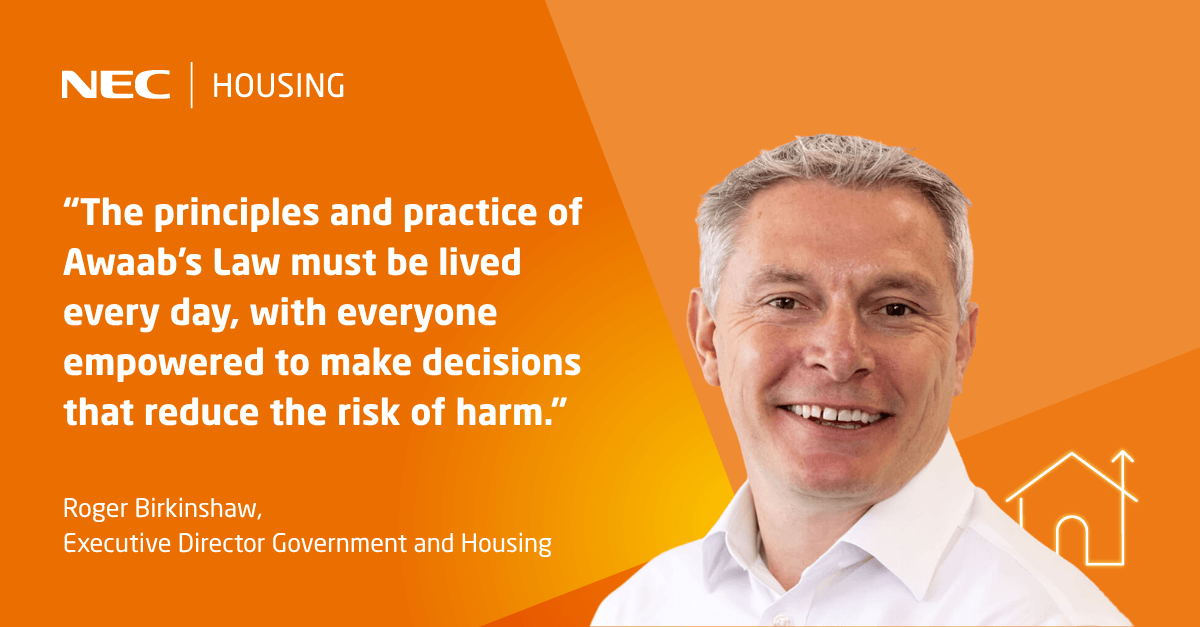
The principles and practice of Awaab’s Law must be lived every day, with everyone empowered to make decisions that reduce the risk of harm. That’s much harder than buying a new bolt-on system that promises compliance, but it’s the only effective way forward. NEC Housing can make things easier, because the software to help Awaab’s Law compliance is ready out of the box. But let’s not underestimate the extent of the change required.
To explore how NEC Housing can support your Awaab’s Law compliance, get in touch.