



 5 March 2026 · Articles
x
Top 5 AI Trends Enterprises Should Watch in 2026
Why AI Strategy in 2026 Will Be evaluated by Outcomes, Not Innovation
For most enterprises, the AI conversation has shifted. The question is no longer “Can we build AI?” but “Can we run AI reliably, responsibly, and at scale?”
Over the last few years, organisations have experimented with pilots, proofs of concept, and isolated use cases. In 2026, that phase is ending. AI is moving from the edges of innovation labs into the core of enterprise operations, touching customer experience, engineering productivity, risk management, compliance, and decision-making itself.
What separates leaders from laggards is not access to advanced models, but how well AI is integrated into everyday workflows, governed across the enterprise, and trusted by people who depend on it.
Let’s discuss trends that define how AI will shape enterprise technology strategies in 2026, not as hype, but as operational reality.
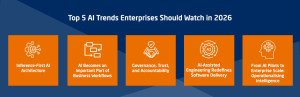
1. Inference-First AI Architecture
For years, AI investment was dominated by model training, larger datasets, bigger GPUs, and increasingly complex architectures. In 2026, the emphasis has shifted decisively toward inference.
Enterprises are prioritising how quickly, reliably, and cost-effectively AI delivers decisions in real business contexts. Intelligence is being embedded closer to where data is generated, inside applications, platforms, and edge systems, so insights can be acted on immediately.
This matters because most enterprise value from AI depends on timing. Fraud detection, system anomalies, customer interactions, operational alerts, these lose value if responses arrive seconds too late.
Inference-first architecture enables:
- Real-time decision-making inside workflows
- Lower latency and reduced dependency on centralised systems
- More predictable operational costs
- Better resilience when connectivity is limited or disrupted
By 2026, AI systems that cannot operate efficiently at inference time will struggle to justify their place in production environments.
2. AI Becomes an Important Part of Business Workflows
One of the biggest mistakes enterprises made during early AI adoption was treating AI as a separate destination, something employees had to invoke, query, or consult.
That model does not scale.
In 2026, AI increasingly functions as operational intelligence, embedded into business processes and applications, operating continuously in the background. Instead of asking AI for insights, systems proactively surface recommendations, automate routine decisions, and flag risks as work happens.
This shift has important implications:
- AI adoption improves because users do not need to change how they work
- Productivity gains compound over time instead of plateauing
- AI becomes part of operational muscle memory, not an optional tool
The most effective AI implementations are invisible. They assist without interrupting, guide without overwhelming, and automate without removing accountability.
3. Governance, Trust, and Accountability
As AI systems begin influencing core decisions, financial, operational, regulatory governance is no longer a technical concern. It is a leadership responsibility.
In 2026, enterprises are formalising AI governance frameworks that address:
- Ownership of AI decisions and outcomes
- Explainability of recommendations
- Data lineage and model transparency
- Risk management and regulatory compliance
- Ethical use and bias mitigation
Trust has become the limiting factor for AI scale. Leaders do not need to understand model architectures in depth, but they do need confidence in why a system produced a recommendation and who is accountable for acting on it.
Organisations that fail to establish trust early often see AI initiatives stall, not because the technology fails, but because decision-makers hesitate to rely on it.
AI governance is no longer about control alone. It is about enabling safe acceleration.
4. AI-Assisted Engineering Redefines Software Delivery
Software development has entered a structural shift.
AI-assisted coding, testing, and DevOps are no longer productivity experiments—they are becoming standard components of modern engineering teams. In 2026, the advantage does not come from replacing developers, but from augmenting how teams build, test, deploy, and operate systems.
AI is reshaping engineering in several ways:
- Accelerating code creation and refactoring
- Detecting defects and security vulnerabilities earlier in the lifecycle
- Generating and maintaining automated tests
- Optimising CI/CD pipelines and cloud resource usage
- Reducing cognitive load on engineers
The most important outcome is not speed alone. It is consistency, fewer production incidents, better code quality, and more predictable delivery.
Organisations that integrate AI into engineering workflows see compounding benefits over time, while those that treat it as an optional tool often fail to capture lasting value.
AI-assisted engineering shortens time-to-market by accelerating development, testing, and release cycles while reducing late-stage defects. The result is faster delivery with fewer production issues, enabling teams to scale innovation without increasing operational risk.
5. From AI Pilots to Enterprise Scale: Operationalising Intelligence
Many enterprises have no shortage of AI pilots. What they lack is a clear path to scale.
In 2026, the winners will be those who shift focus from experimentation to operationalisation, making AI reliable, repeatable, and embedded across the business.
Key characteristics of scalable AI programs include:
- Clear alignment between AI initiatives and business KPIs
- Standardised platforms and tooling
- Strong data foundations and integration strategies
- Consistent governance models
- Ongoing workforce enablement
Scaling AI is less about choosing the right model and more about building the organisational capability to sustain it. This includes training teams to work confidently with AI systems and designing processes that evolve as models improve.
What Enterprise Leaders Should Do Now
As 2026 approaches, enterprise leaders should resist the urge to chase every new AI capability. Instead, focus on fundamentals that enable long-term success.
Key actions to take:
- Invest in inference-ready architectures, not just model experimentation
- Embed AI directly into workflows rather than creating parallel systems
- Establish governance frameworks before scale, not after
- Enable engineering teams with AI-augmented delivery practices
- Align AI initiatives with measurable business outcomes
AI is no longer a side project. It is becoming a foundational layer of enterprise operations.
Leaders who approach AI with the same discipline applied to finance, security, and infrastructure will not only reduce risk, they will unlock sustainable competitive advantage in a world where intelligence is everywhere, but execution still matters most.
About NEC Software Solutions India — AI Capabilities
At NEC Software Solutions India, we work with enterprises that want to use AI in a practical, responsible way, not as an experiment, but as part of how their business runs. Our focus is on helping teams apply AI where it matters most: inside real workflows, engineering processes, and decision-making systems.
Our AI capabilities span across Agentic AI and RAG, inference-first architectures, AI-assisted coding, and intelligent automation, with a strong emphasis on governance, security, and scalability.
Learn more about our AI capabilities here.
Get in touch with us: india.marketing@necsws.com
Related insights
5 March 2026 · Articles
 6 January 2026 · Articles