



 5 March 2026 · Articles
x
Top Five digital trends for STM Publishers in 2026
The digital publishing industry is experiencing a substantial growth with the global market valued at 186.77 billion dollars in 2023 and projected to grow to 402.7 billion by 2032 at a CAGR of 9.67%. This shows the rapid digital transformation in publishing industry. Similarly, STM publishers are focusing on advancing the digital shift from print to online. Their key areas for digital transformation are modernizing outdated workflows, integrating AI, navigating the shift towards Open Access (OA), and enhancing the overall author and user experience.
The 2026 presents an inflection point, as the shift is a full-scale reinvention of workflows, business models and user experience. This evolution caters to various stakeholders in scientific, medical and technical publishing ecosystem.
Below are the five trends to watch and act upon
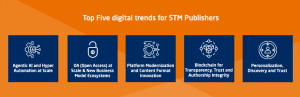
1. Agentic AI and Hyper Automation at Scale
Publishers are now leveraging AI for complete publishing process from manuscript screening to categorisation, finding the experts of similar background and research for peer review and ensuring research integrity. The next step towards AI implementation, probably from 2026 would be the use of “Agentic AI” and full-blown hyper automation to streamline end-to-end publishing workflows.
The combination of Agentic AI and hyper automation (AI + machine learning + robotic process automation) can automate 75% of repetitive tasks in publishing process. The business value of AI adoption is great as it helps in publishing faster, reduces costs, improves visibility and connects content with the right audience and more effectively.
2. OA (Open Access) at Scale & New Business Model Ecosystems
The open access is a standard expectation in scientific publishing and approximately half of the scholarly articles are now published with open access. Publishers are increasingly embracing free access models and online repositories to make research easier to share and access.
The legacy subscription model, where readers had to pay for journal subscriptions are becoming less popular and being replaced by flexible payment models like institutional partnerships and micropayments.
3. Platform Modernization and Content Format Innovation
For publishers the other big wave of digital transformation is to make the workflow more efficient, modern and interactive. They intend to make their systems and infrastructure which offers efficient workflow management, data driven, accelerate content creation and produce rich content formats which are interactive, comprises audio and video and are data-linked.
As per the reports by STM Association, by 2020 89% of the scientific and technical publications were in digital formats and the printed publications kept on decreasing in use. As mentioned earlier the next frontier of digital transformation would be publishing platforms offering immersive and interactive experiences, where complex concepts can be explained through 3D visualization, simulation and augmented reality.
4. Blockchain for Transparency, Trust and Authorship Integrity
For STM publishers, blockchain technology quietly redefines trust, it can create secure and unchangeable records of each step in publishing process – including manuscript submission, peer review, authorship and the source of research data. Major publishers have started testing how blockchain technology can make the publishing process more secure and transparent.
As research becomes more open and transparent, blockchain helps to prove who wrote the paper, record when it is submitted and protect the integrity of content across different platforms. In addition, smart contracts and token-based reward systems could be used to automate payments or giving credit to peer reviewers and manage rights more efficiently.
The STM publishers must lay a strong foundation of building common standards, clear governance policies and measurable business value, for blockchain to become a powerful enabler of transparency, accountability and trust across the entire research publishing ecosystem.
5. Personalization, Discovery and Trust
Content is the king, and the digital media comprises of overwhelming amount of content, hence the key differentiator for STM publishers is the ability to help authors and readers to help discover, engage and trust content. Hence publishers are focusing on hyper-personalisation to make reading experience and content delivery process more customized for each person. They are also leveraging better tagging and meta data so that research papers are better to find in research engines and databases. Publishers are also investing on data integrity to ensure published research is authentic, original and trustworthy.
These practices will help publishers to become more tech-driven and trustworthy, while readers will get a more personalised, reliable and easily searchable research experience.
Conclusion
At STM publishing enters 2026, the focus is on embracing higher technologies like AI, hyper automation, transparency and personalization. Embracing these technologies will redefine how research is created, managed, shared and trusted, driving a more efficient, accessible and credible future for scholarly research and communication.
About Us
NEC Software Solutions India is a trusted technology partner to global publishers (STM & general publishers), academic societies, and associations. We specialise in delivering tailored digital solutions that streamline publishing operations, enhance user experiences, and support content accessibility across platforms. With deep domain expertise and more than 20 years of experience, we help publishing organizations adapt to evolving market needs and deliver greater value to their communities.
Our approach is built on two key pillars: strong service delivery grounded in proven methodologies, a deep understanding of the publishing ecosystem that drives innovation and best practices.
To know more about our publishing services, email us at india.marketing@necsws.com.
Related insights
5 March 2026 · Articles
 22 January 2026 · Articles