




Small force, big ambition: the view from Derbyshire Constabulary’s control room
Catherine Levin, Editor at Emergency Services Times, visited Derbyshire Constabulary to see how the force uses ControlWorks as the foundation for its contact, command, and dispatch operations
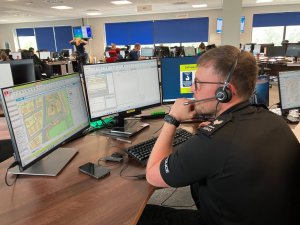
Photo credit: Emergency Services Times
Derbyshire Constabulary is steadily reshaping how it protects the public by building a technology ecosystem around NEC’s ControlWorks platform, using it as the digital ‘front door’ for almost everything that touches frontline policing.
At the heart of this transformation is Superintendent Adam Wilkins, Head of Contact Management. He is responsible for all call handling, dispatch, initial crime reporting and enquiry office functions. I spoke to him on a recent visit to the force control room. He describes his part of the organisation as under constant pressure but increasingly empowered by technology.
“The control room is the front door to everything that touches the frontline police officer for response, from homicides to missing persons and concerns for safety, everything will come through contact management.”
One platform for contact, command and dispatch
Derbyshire Constabulary runs its contact and dispatch operation on ControlWorks, NEC’s single platform for incident and resource management. All emergency (999), non-emergency (101) and digital contacts feed into the same environment. This joined‑up workflow means that whether it’s a shed burglary with no suspect on scene or a crime in progress, the system supports the right response. Moving seamlessly from contact to dispatch to investigation on a single system is critical for both efficiency and public safety.
Smarter deployment of officers and specialist skills
ControlWorks doesn’t just track incidents; it also exposes the status, skills and capabilities of officers across Derbyshire. Officers book on at the start of a shift, and from that point they’re visible and deployable through the system: This allows dispatchers to match the right skills to the right risk. For example, ensuring a Taser‑trained officer attends a volatile incident or sending an advanced driver to a serious road traffic collision.
Location awareness is also increasingly data‑driven. Modern vehicles and devices can automatically trigger alerts into the system if a collision is detected. Adam explains:
“A lot of modern cars will have some sort of system within the car that if there’s a collision it knows something’s not right and it will automatically send an alert to the emergency services. Apple Watch and phone SOS features now generate similar notifications as well.”
Once that alert has been added to ControlWorks, the system helps dispatchers find the nearest available resource, within seconds, rather than simply the next officer in a queue. That proximity‑based deployment can make a tangible difference in life‑threatening scenarios.
Managing demand surges and repeat callers
It is no surprise that contact management faces complex patterns of demand: sudden surges after major collisions, clusters of calls around a single incident, and repeat callers ranging from highly vulnerable victims to vexatious individuals. Adam illustrates this point by describing what happens when a serious collision triggers dozens of 999 calls:
“We put out a flash message across the control room, so that officers can see it on their screen advising that a road traffic collision has been reported, we are aware and responding.
When someone then calls 999 to report it, we all know, and we’ll do a quick polite response along the lines of ‘We’re grateful for your call, we’re aware and we’ve got officers attending.’ It means we can quickly close the call, after capturing a basic account from the caller and move on as it’s not new information.”
This practical but simple solution frees call handlers to stay available for time‑critical emergencies, such as domestic abuse incidents. Critically this also prevents ‘over-deployment’ so that officers remain available for other incidents without losing public confidence that police are already on scene.
While a large incident will inevitably result in repeat calls, other types of repeat demand are also surfaced through ControlWorks. The force manages this via a dedicated contact management team that looks at patterns across policing and partner agencies, particularly where vulnerability or mental health is involved.
Building an eco-system around ControlWorks
Derbyshire’s strategy is to treat ControlWorks as the operational core and then wrap additional capabilities around it, gradually increasing integration. Adam explains that this includes access to CCTV feeds from commercial and public sector providers.
Social media monitoring tools such as Orlo are also in use. The digital contact team sit as part of the control room, taking reports directly via social media, monitoring the force’s feeds in respect of ongoing incidents and investigations and accessing ControlWorks to get a wider picture of incidents.
Even video gets a look in with the use of NEC’s ResponsEye, allowing a contemporaneous video feed to stream into the control room. Adam says that’s at an early stage for the force but he thinks it has great potential to improve situational awareness.
Reflecting on the approach the force is taking, Adam characterises the current position as “core capability in place” with “loads of potential to integrate everything together.” It seems the main challenges that limit his ambition are budget constraints, contract cycles and legacy IT systems.
For him, the direction for technology in his control room is clear: a single operational picture for controllers, regardless of how many specialist systems sit behind it and underpinning that is a clear integration strategy that allows disparate systems to talk to each other and minimise the risk.
Exploring AI for live risk assessment
During my visit, we talk about how the force is using artificial intelligence (AI) in the control room. They are testing out an in-house AI‑driven call‑listening and risk assessment tool that sits alongside ControlWorks. Adam provides more detail:
“We’ve been trialling a solution that listens into a call and tries to start almost kind of transcribing and working out the risk objectively. Control room staff on each shift are testing it and feeding back on how to optimise it. It’s an exciting period for us, developing a tool with our own teams, seeing how it can improve what we do.”
Unlike retrospective analytics, this approach is intended to support real‑time decision‑making: surfacing risk factors, ensuring vulnerability isn’t missed, and helping call handlers structure their assessment under pressure. Adam is keen to reinforce that this work is being developed in partnership with national teams, along with Derbyshire applying rigorous validation methods to test accuracy and ethics before any wider rollout. It’s early days, but good to see new ways of introducing AI into the control room here in Derbyshire that could be used by other forces in the future. Scalability is key.
A strong relationship behind innovation
Spending the afternoon in the control room in Derby is instructive; with the hum of activity across the teams, there is a quiet and authoritative tone that runs throughout. Talking to Adam who is immersed in the day to day and former Derbyshire officer, Liam Caldecott who now works for NEC, it is clear that the relationship between customer and supplier is strong here.
Liam worked for the force for years before stepping away and landing in the private sector. He returns to the force he knows in a different capacity and watching him talking to the officers, helping them, working through solutions in a quiet and calm way, his relationships are powerful and deeply rooted. He is part of the NEC eco-system that has seen the force create an internal subject‑matter expert role dedicated to optimising ControlWorks and participate in user-groups and collaborate with neighbouring forces running the same platform.
“We’re always keen to kind of give it a go, and someone’s got to take the leap,” offers Adam and that sums up how Derbyshire and its partnership with NEC works so well. Together they are forging a path to incremental but meaningful gains in public safety, from faster, smarter deployment to better handling of vulnerability and risk across every contact channel.
_
Author: Catherine Levin, Editor, Emergency Services Times