


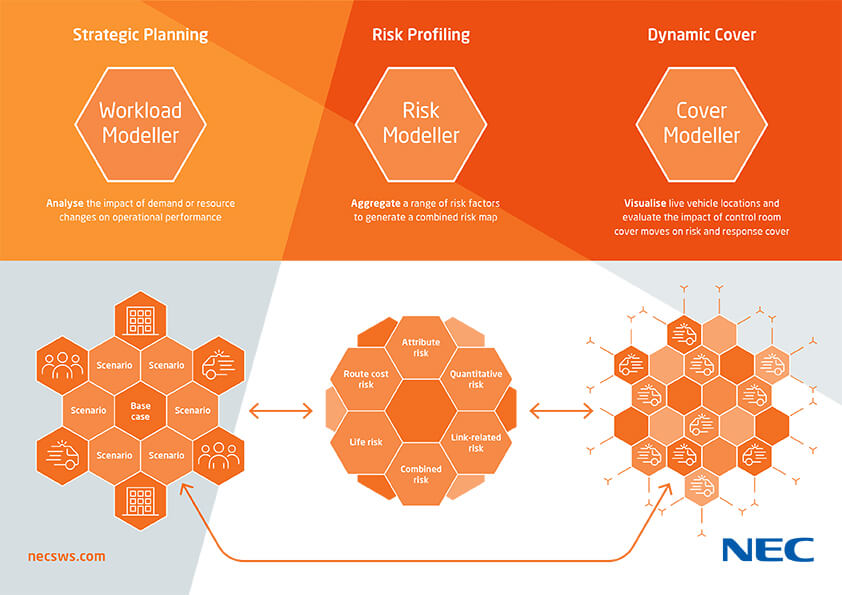
Analyse the impact of demand or resource changes on operational performance
Workload Modeller operates on data about when and where incidents occur, relating this to emergency services resources and the constraints under which they operate.
Using simulation modelling techniques, it removes the guesswork involved in answering ‘What if?’ questions. Emergency services can test the outcome of various resourcing scenarios such as closing, relocating and merging stations, changing the type and location of vehicles, designing new shift patterns and balancing the mix between whole-time and retained availability.
Contact Us Today
Integrated within the GIS

Integrated within the GIS
The close integration with SIS Desktop allows the analysis to be carried out within the context of other GIS overlays.
The interface enables users to easily build resources sets and analyse the impact on operational performance. Reporting options include a wide range of maps, tables, and charts.
Additional capability that allows emergency services to analyse historic and future demand
Emergency services can make changes to the resources sets (stations, vehicles and shifts) and analyse the impact of those changes on the ability to meet their operational performance targets.
Scenario outcomes can be generated with a simulation engine that follows the incident response process. For every incident, the application uses travel times based on a road network to identify the vehicles and crews best placed to respond to that incident. It then makes those resources unavailable for the duration of the incident and works through the simulated allocation of resources to meet demand within a given time-period.

Related specialist modelling applications
Related specialist modelling applications
Workload Modeller, Risk Modeller, and Cover Modeller are designed to be interoperable and can be integrated together or deployed as separate applications.
Risk Modeller provides analytical functionality to aggregate a range of risk factors to generate a combined risk map. Cover Modeller allows control room personnel to test the impact of potential resource relocation and make informed decisions on cover moves.
Take a closer lookRELATED PRODUCTS AND SERVICES
Latest Insights